
Day 127: The Probability Fallacy
Your brain is tricking you
“Everyone loses their way at some point, and it’s not just because of their mistakes or the decisions they make. It’s because they’re horribly, wonderfully human. And the one thing I’ve learned about being human is that we can’t do this alone. When we’re lost, we need help to try to find our way again.”― T.J. Klune, Under the Whispering Door

Welcome to A Reading Journey. This is a blog about reading. Not books, book reviews, author interviews, or any of that good stuff. That’s for other blogs. This blog is about reading. I hope that by sharing my reading journey, you might find yourself reading more or differently.

Reading Tips
Tip 138: Logical Fallacies Pt. 1: The Probability Fallacy
A fallacy is the use of faulty logic in putting forth an argument. We’re going to learn about fallacies so that we can see how they might play a role in the novels we read.
Today’s entry is a simple one, the probability fallacy aka the Appeal to Probability. Here’s how the faulty logic works: A is possibly true —> so that means A is probably true —> which means we can assume that A is true.
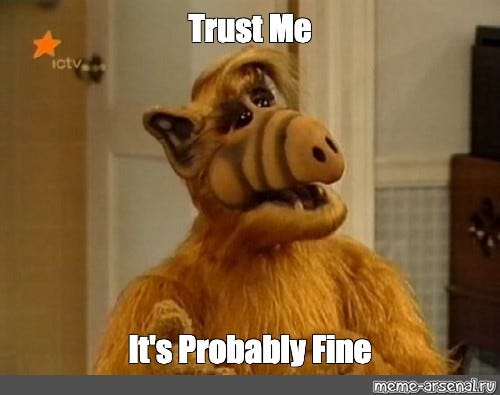
I know, broken down like that it looks ridiculous, but it’s an incredibly common fallacy. Here’s how it might look in your own life.
(At the grocery store) Hmmm, this canned chili looks like it could be OK. (checks price) Yeah, this is probably fine for a quick queso dip. (can goes in cart) (later at home) Hey, I picked up this great canned chili. Let’s make some queso dip.
You can see how easy it is to slip into the fallacy and how it picks up momentum as it goes.
When I read about this, I immediately thought of The Grapes of Wrath. The Joad family is settled in a nice camp that has bathrooms with running hot and cold water and supportive people living there and running it. But they don’t have jobs, so they are running out of money to buy food.
They are offered jobs at a farm up the road, which would use up all their remaining money for gas. But there is the possibility that this farmer won’t cheat them and that they will make enough money to finally get somewhere stable to live.
The possibility eventually becomes a probability in their minds and finally a truth so powerful that they ignore all evidence to the contrary.
In fact, this fallacy drives their entire story — the flight from Oklahoma out to California in search of jobs that could possibly exist based on a flier they saw.
Even when people leaving California to move eastward tell them there are no jobs, they continue the possible/probable/truth that they will find the promised land when they arrive. They are too invested in the vision to hear information that contradicts it.
There are other fallacies operating here as well, particularly the sunk cost fallacy, which we’ll talk about at a later date. But for now, I want you to focus on the possible/probable/truth pipeline and look at where you might have seen that in stories.
I think romance writers use this to great effect in the enemies to lovers trope. The female protagonist hears a rumor that the Duke is a rake. When she meets him, there’s something in his attitude that quickly moves her from “he’s possibly a rake” to “I think he’s leering at me” and finally, “he’s definitely a dangerous rake, and I must stay away from him.” The author has used the fallacy to set up the trope which will hook many romance readers.
Ripped straight from the headlines, mystery novelists also make hay with this fallacy. The detectives find that a suspect has a motive and become fixated on that person, leading them to ignore all other potential suspects. Motive (they possibly committed the crime) —> motivated reasoning (I didn’t like the way they acted when I interrogated them) —> holding a press conference to announce that they definitely committed the crime.
Think about the books you’ve read recently. Can you spot the author using the probability fallacy to enrich the story? Tell me about it in the comments.

Today’s Reading
FICTION BOOKS
The Defixio: Chapter by A.M. Blackmere #Horror #SubstackSerial
Under the Whispering Door by TJ Klune #ReRead #Death #Grief #Audiobook
One for Sorrow by Sarah A. Denzil #Thriller #Audiobook
Great Expectations by Charles Dickens #BookClub #Classic #Audiobook
Babel Tower by A.S. Byatt #Literature #PrintBook #TriggerDomesticViolence #TriggerCult #TriggerChildAbuse #TriggerSuicide #TriggerChildEndangerment
Les Misérables by Victor Hugo #BookClub #Audiobook #HistoricalFiction #Classic #France #Literature
SHORT STORIES
“No Good Deed” by Ray Garton
NONFICTION BOOKS
The Daily Buddhist by Pema Sherpa, Brendan Barca #Spirituality #Audiobook
10 Women Who Ruled the Renaissance by Joyce Salisbury #GreatCourses #History #Audiobook
City of Fortune: How Venice Ruled the Seas by Roger Crowley #Worldbuilding #History #Italy #Venice #Seaport #Ebook
A Literary Tour of the United States by Arielle Zibrak #GreatCourses #Audiobook
POETRY
The Poet Goes to Indiana by Mary Oliver
ARTICLES AND OTHER NON-BOOK READING
Woman of the Day:
Faith Ringgold (born Faith Willi Jones; October 8, 1930 – April 13, 2024) was an American painter, author, mixed media sculptor, performance artist, and intersectional activist, perhaps best known for her narrative quilts.
INFORMATION GATHERING
Quotes
When we trust our creative energy, we encounter a supreme kind of enjoyment—an amazement at the natural unfolding of life beyond our ordinary way of looking at things. — Dzigar Kongtrul Rinpoche
Journaling Prompts
What form(s) of creativity do I find healing?
Vocabulary
To be wistful is to have sad thoughts and feelings about something that you want to have or do, and especially about something that made you happy in the past. Wistful can also describe something, such as a smile or sigh, that shows or communicates such feelings.
As the car pulled away, Lea cast one last wistful glance at the house where she’d spent so many happy years.
“Postcards have always been an object of fascination for me. I remember flipping through photo albums as a young girl and coming across those sent to my parents, from people I had never met. When I asked who these people were, I would hear wistful stories.” — Minoli Wijetunga, The Guardian (London), 10 Jan. 2026
We see you there, dear reader, gazing silently up at the moon, heart aching to know the history of wistful, as if it could be divined on the lunar surface. And we’d like to ease your melancholy by telling you that the knowledge you seek—nay, pine for—is closer at hand. The word wistful comes from wistly, a now-obsolete word meaning “intently,” and the similar-sounding wishful. Wistly, in turn, likely comes from whist, an old term meaning “silent.” What’s more certain is that our modern wistful is a great word to describe someone full of pensive yearning, or something inspiring such yearning.
Thanks for reading with me today. I’d love to hear from you about your reading journey, and especially what you’re reading right now.
