
Day 162: Benefits from Reading Poetry Pt. 3
And writing!

“Nothing takes the heart out of a man more than the expectation of failure.”
― Robin Hobb, Assassin’s Apprentice
Welcome to A Reading Journey. This is a blog about reading. Not books, book reviews, author interviews, or any of that good stuff. That’s for other blogs. This blog is about reading. I hope that by sharing my reading journey, you might find yourself reading more or differently.

Reading Tips
Tip 168: Benefits from Reading Poetry Pt. 3
Today I’m going to look at some research showing how poetry is being used to support people dealing with the after effects of trauma.
This study was done on seven men and six women, aged 18–24, who immigrated to Sweden from Afghanistan. “Poetry, both spoken and written, has a long tradition in Afghanistan and is central to the Afghan culture ... Poetry’s unique status within the Afghan culture is highlighted in the expression “Sha’er mega” (The poet says) which is used to substantiate an argument and to highlight its importance ... Poetry has also been recognized as a form of rebellious expression for women and girls in Afghanistan, who endure extreme unequal conditions ...”
The participants were interviewed after having lived in Sweden for 3 to 7 years. The researchers hoped to learn how and why they used poetry and other creative activities to process their trauma and the impact of these activities on their mental health.
“Four of them wrote poetry, two wrote short stories, two were engaged in painting, one used music and lyrics as a creative expression, and one expressed an ambition to find a place to construct “something” together with other teenagers.”

All participants were asked “Can you please tell me about your first time in Sweden?”.
Following that question, the interview was more free flowing and covered everyday life experiences, understanding of integration into a new culture, experiences of interventions and activities that promoted integration, and a discussion of how others like them could be supported.
All the participants described intense longing for family and familiar places as well as anxiety about an uncertain future. They described feeling “in between.” Adults who worked with them actively encouraged the use of creative expression. One participant said “When I was new, I didn’t know that a pen and a piece of paper could help you feeling better”.
“They mentioned the opportunities to learn and work together with others in a group but also to practice and learn the Swedish language. Involvement in creative activities with peers could also generate new friendships and a larger social network, something that according to our participants is crucial for experiences of integration. They also described how access to a social context and friends was associated with a sense of ‘normality’ in relation to peers.”
Although most of this particular research deals with the writing of poetry, participants also talked about sharing it with others. Having other people read their poems helped them feel seen and accepted. They anticipated the perspective taking that their poetry enabled, and it helped them feel less isolated.
“Through writing poetry … that was rooted in their own life situations and the struggles they faced, our participants got a sense of recognition from others. Importantly, they also became recognized by themselves.”
Have you used creative expression as a way to navigate challenging situations? Have you used reading as a way to learn about and understand situations that you’ve never experienced? I’d love to hear about it in the comments.
Today’s Reading
FICTION
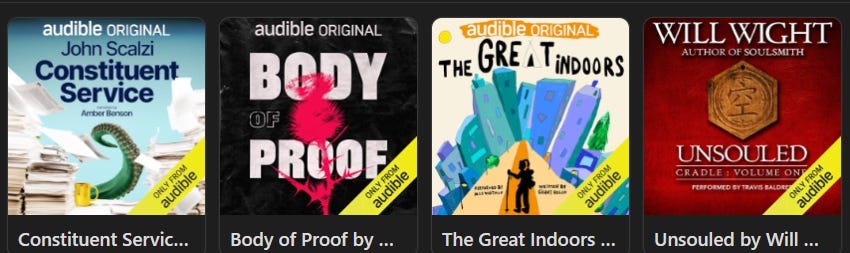
Assassin’s Apprentice by Robin Hobb #Fantasy #Series #Audiobook
Couriers Outbound by pirateaba #Fantasy #LitRPG #Series #Audiobook
Great Expectations by Charles Dickens #BookClub #Classic #Audiobook
Babel Tower by A.S. Byatt #Literature #PrintBook #TriggerDomesticViolence #TriggerCult #TriggerChildAbuse #TriggerSuicide #TriggerChildEndangerment #Divorce
Les Misérables by Victor Hugo #BookClub #Audiobook #HistoricalFiction #Classic #France #Literature

SHORT STORIES
“The Library of the Apocalypse” by Rati Mehrotra


NONFICTION
The Daily Buddhist by Pema Sherpa, Brendan Barca #Spirituality #Audiobook
The Goncourt Journals by Edmond and Jules Goncourt #Ebook #InternetArchive #JournalProject
POETRY
An Angel Visitant by Samuel Taylor Coleridge
ARTICLES AND OTHER NON-BOOK READING
Woman of the Day:
Anna Apostolaki (Greek: Άννα Αποστολάκη, 1880–1958) was a Greek archaeologist and museum curator. She was the first Greek woman to work as a professional archaeologist and served as curator and later the director of the National Museum of Decorative Arts. One of the first women to graduate with a doctoral degree, she was also the first woman member of the Archaeological Society of Athens and an early member of the Christian Archaeological Society. She was an expert in ancient textiles and saw preservation of ancient patterns and Greek weaving traditions as a means to not only support women’s traditional work, but bolster Greek nationalism in the interwar period of Greek history.
INFORMATION GATHERING
Quotes
I will never apologize for embracing joy and beauty — even when the world is falling apart — because joy and beauty are my fuel for activism. — Karen Walrond
Journaling Prompts
Which of my values needs tending today?
Vocabulary
Blandishments are nice things that you say or do to convince someone to do something. Blandishment is usually used in the plural form.
Despite the many blandishments of the dressing room attendant, we were resolved not to overspend at the fashion boutique.
“… he sought to turn the attack around by saying his vast wealth—which has allowed him to richly fund his political endeavors—made him immune to the blandishments of plutocrats and corporate interests.” — Mark Z. Barabak, The Los Angeles Times, 23 Feb. 2026
When Star Wars audiences first meet former smuggler Lando Calrissian—played iconically by Billy Dee Williams—in The Empire Strikes Back, he is full of blandishments, offering flattery (telling Leia “You truly belong here with us among the clouds”) and gifts to our heroes in the form of food and drink (“Will you join me for a little refreshment?”) in order to entice them into what we soon discover is a trap. Notably, before the whole sordid deal goes down (and before Lando’s eventual redemption), Han Solo calls him “an old smoothie.” Lando’s verbal smoothness can be linked to blandishment too: the word was formed from the verb blandish, meaning “to coax with flattery.” Blandish ultimately comes from the Latin adjective blandus, meaning “influencing others by flattery,” source too of our adjective bland, which typically describes things boring and flavorless but which can also mean “smooth and soothing in manner or quality”—a meaning that also applies to everyone’s favorite Cloud City administrator.
Thanks for reading with me today. I’d love to hear from you about your reading journey, and especially what you’re reading right now.