
Day 77: Curiosity
Don't worry, because you're not a cat

“I can discover facts, Watson, but I cannot change them.”
― Arthur Conan Doyle, The Problem of Thor Bridge
Welcome to A Reading Journey. This is a blog about reading. Not books, book reviews, author interviews, or any of that good stuff. That’s for other blogs. This blog is about reading. I hope that by sharing my reading journey, you might find yourself reading more or differently.

Reading Tips
Tip 96: Curiosity
Today I’m reading a great article about curiosity that comes to us from neuroscientist Anne-Laure Le Cunff. Let’s dig in!
The first thing she tells us is that curiosity releases dopamine, the reward chemical that makes it more likely that you are going to continue that behavior. So curiosity is rewarding and leads to more curiosity. Many of us read to learn because we’re curious. I never knew that opening a book or pushing play on an audiobook was releasing dopamine, but I did know that I am always excited to start reading. Now that excitement makes sense!
Next she tells us that curiosity activates the hippocampus, making it easier for us to learn and to retain what we’ve learned. Finally, curiosity promotes neuroplasticity, which is the rewiring of the brain. Neuroplasticity is amazing, because who wants to stop learning as soon as they aren’t a toddler anymore? If you want to learn a new skill, from software programming or a new language to how to play the guitar, you’ll need neuroplasticity.
Curiosity can also decrease your stress level. Uncertainty and the fear of the unknown activates the amygdala, the reptilian portion of your brain that is equivalent to the RED ALERT signal on Star Trek. Curiosity says, “Hold on. We don’t know what’s happening, so let’s be curious instead of afraid.” Imagine how much stress you might avoid by exercising curiosity in place of fear. If you struggle with anxiety, this could be a magic bullet for you.
Anne-Laure explains how your brain needs to balance between the default mode network (imagination and introspection) and the executive control network (goal-directed behavior). As a person with ADHD, I can tell you that when this balance goes awry, bad things happen. Good news! Curiosity can balance these out.
I’m going to take a side trip here to clarify the difference between curiosity and imagination. Curiosity is the act of asking why. Imagination is about asking what if.
Curiosity: why isn’t my dog learning this trick?
Imagination: what if I tried teaching the trick a different way?
What Anne-Laure is saying is that imagination can get out of control and derail your progress toward goals. Or vice versa. Curiosity can balance that out.
The big payoff for this article is not about reading, but I think it’s worth talking about here anyway. Anne-Laure gives us 5 ways that curiosity can help us navigate change.
First, look at how you word your reaction. Instead of responding with “what now?” ask “why?” This takes the reaction out of the amygdala and puts it into the prefrontal cortex where you can process what’s actually happening with logic and curiosity.
Second, treat your life like an unfolding mystery to be solved. She calls this “taking field notes.” Write down all the things you do or things that happen to you as if you are discovering something new that must be explored. “Today I noticed X and wondered why…” That’s not a bad tip for making notes about your reading, either. Don’t limit yourself to writing down things you want to remember. Write down things you want to explore further.
Third, you’ve got your field notes, now run some “tiny experiments.” Just take a small step or two toward discovering “what if?” Perhaps you wrote in your field notes, “I noticed that I don’t have many hobbies. A tiny experiment might look like attending a hands-on art class at the library, or having a friend who loves board games teach you their favorite one, or listening to an audiobook for the first time.
Fourth, practice saying “I don’t know yet.” It’s ok not to know. Not knowing is the start of the adventure of finding out. Embracing uncertainty encourages creative problem solving through asking “why?” and then trying out some tiny “what if” experiments.
Finally, remove the word failure from your vocabulary. It’s just data about what didn’t work. That data is what helps us learn and grow. I took a class from Carolyn Dube, an inspiring artist who helps non-artists believe in themselves. She won’t even let you use the word “mistake”. It’s an OOPS instead: Outstanding Opportunity Presenting Suddenly.
Anne-Laure sums it all up like this: “So, the next time you face a big change and feel anxious or stuck, try asking yourself a simple question: What if I got curious instead?”

Today’s Reading
FICTION BOOKS
Surfacing by Margaret Atwood #FeministLiterature #DivorceAftermath #Audiobook
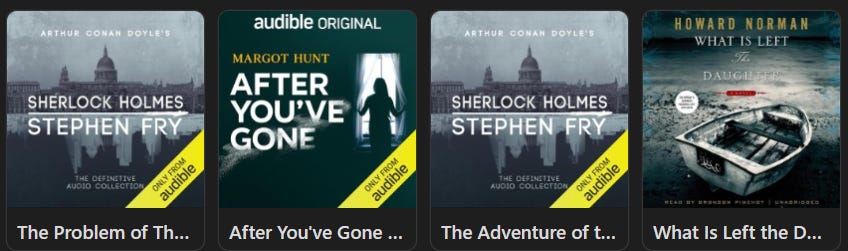
The Adventure of the Devil’s Foot by Sir Arthur Conan Doyle #Mystery #Audiobook [completed #69]
The Problem of Thor Bridge by Sir Arthur Conan Doyle #Mystery #Audiobook [completed #70]
Carpe Jugulum by Terry Pratchett #Discworld #Series #Witches #Fantasy #Audiobook
Babel Tower by A.S. Byatt #Literature #PrintBook #TriggerDomesticViolence #TriggerCult #TriggerChildAbuse #TriggerSuicide #TriggerChildEndangerment
Les Misérables by Victor Hugo #BookClub #Audiobook #HistoricalFiction #Classic #France #Literature
SHORT STORIES
“The Adventuring of the Creeping Man” by Sir Arthur Conan Doyle
“The Adventure of the Sussex Vampire” by Sir Arthur Conan Doyle
“The Adventure of the Three Garridebs” by Sir Arthur Conan Doyle
POETRY
Watching the Sea Go by Dana Levin
ARTICLES AND OTHER NON-BOOK READING
Substack
“Worldbuilding Guide: Fungi - Hallucinogens” by Ian Dunmore
Elsewhere
Woman of the Day:
Rekha Raju is an Indian classical dance performer and teacher from Bangalore, Karnataka. She specialises in the Bharatnatyam and Mohiniyattam dance forms.
INFORMATION GATHERING ~ NOT READING
Quotes
The function of freedom is to free someone else. — Toni Morrison
Journaling Prompts
How can I make a positive difference for someone who is suffering?
Vocabulary
Nadir (n) refers to the lowest or worst point of something. When used in astronomy, nadir describes the point of the celestial sphere that is directly opposite the zenith and vertically downward from the observer.
Only once the novel’s protagonist reaches her nadir does she arouse the reader’s empathy, and we root for her to climb back to respectability.
“Sacrament dives right into the nadir of the 2020 health crisis, following a group of nurses who have moved into makeshift housing near a California hospital, to isolate from their families during the height of the case surge.” — James Folta, LitHub.com, 1 July 2025
Nadir is part of the galaxy of scientific words that have come to us from Arabic, a language that has made important contributions to the English lexicon especially in the fields of mathematics, astronomy, medicine, and chemistry. The source of nadir is naḍhīr, meaning “opposite”—the opposite, that is, of the zenith, the highest point of the celestial sphere which is positioned vertically above the observer. (The word zenith itself is a modification of another Arabic word that means “the way over one’s head.”) Though born of the heavens, both words are called upon to refer to earthy things too, especially a significant point or period of time, be it a high point or low one.

Thanks for reading with me today. I’d love to hear from you about your reading journey, and especially what you’re reading right now.
